
Choosing between ASP.NET Core and Node.js in 2026 impacts performance, scalability, cost, and hiring. This guide breaks down real enterprise factors, benchmarks, and use cases to help you pick the right backend stack for your business goals.
- Key performance and scalability differences between ASP.NET Core and Node.js, with real-world enterprise examples
- Cost implications in 2026, including hosting, development, and long-term maintenance
- Hiring trends and ecosystem maturity, based on current enterprise adoption patterns
- Which framework fits your use case best, SaaS platforms, high-traffic apps, or enterprise systems
ASP.NET Core Vs Node.js: What Enterprises Should Consider in 2026?
ASP.NET Core and Node.js are both strong choices for enterprise backend development. And that is exactly why the decision feels difficult.
On paper, both can scale. Both work well in cloud environments. Both are used in production by large organizations.
It is important to clarify one thing before comparing the two. ASP.NET Core and Node.js do not exist on the same technical layer.
ASP.NET Core is a backend development framework built primarily using the C# programming language. It provides a structured environment for building enterprise applications.
Node.js on the other hand is not a programming language or a framework. It is an open source JavaScript runtime that allows applications to run JavaScript on the server side.
Most enterprise systems built with Node.js rely on additional frameworks and libraries to bring structure and consistency.
This article looks at ASP.NET Core vs Node.js from an enterprise perspective. We will not debate features or benchmarks. Instead, we focus on the practical factors enterprises should consider in 2026 before committing to a tech stack that will shape their software strategy for years.
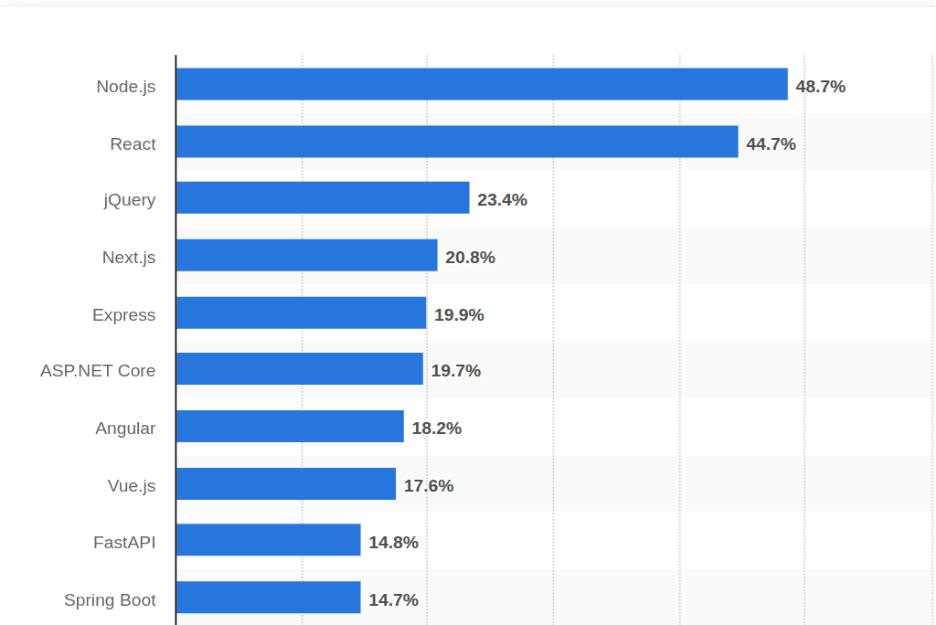
Image from Statista showing most used web frameworks among developers worldwide, as of 2025:
Table of Contents
Enterprise Requirements Have Changed. Has Your Tech Stack Kept Up?
Enterprise applications today look very different from what they did even a few years ago. What once worked for a stable system now struggles under modern business demands.
In 2026, enterprise backend development is expected to support far more than basic application logic. Systems must handle fluctuating traffic and still remain secure and compliant.
At the same time, development teams are under pressure to release faster without compromising stability. This shift has changed what enterprises should expect from a backend tech stack.
Scalability, Security, Maintainability has also become a critical factor. Enterprise codebases tend to live for years. A backend technology that feels productive early on can become difficult to manage as the system grows and business requirements evolve.
What is ASP.NET Core?
ASP.NET Core is a modern backend framework designed for building high performance and scalable enterprise applications. Built primarily using the C# programming language, it provides a structured and opinionated environment that helps teams build, run, and maintain complex systems with consistency.
One reason enterprises continue to trust ASP.NET development is the stability of the Microsoft ecosystem.
From an enterprise application development standpoint, performance is one of ASP.NET Core’s biggest strengths. Its multi-threaded execution model allows applications to efficiently handle CPU-intensive workloads and concurrent requests.
Security is another area where ASP.NET Core fits naturally into enterprise environments. ASP.NET Core also works well for large and structured development teams. Its clear project structure and mature tooling help teams collaborate on large codebases without introducing unnecessary complexity.
What is Node.js?
Node.js has moved far beyond its early reputation as a tool mainly used for startups and MVPs. Today, it plays a meaningful role in enterprise scale applications.
At its core, Node.js uses an event-driven, non-blocking architecture. Node.js backend development fits naturally into API-heavy platforms.

Source: W3Techs.com
Many enterprises use it to build lightweight, scalable APIs that connect front-end applications, mobile apps, third-party services, and data platforms. Node.js also aligns well with microservices and serverless architectures.
Another key advantage is its place in JavaScript-first ecosystems. Common enterprise use cases for Node.js include real-time dashboards, streaming platforms, collaboration tools, customer-facing portals, and integration layers.
ASP.NET Core Vs Node.js: Enterprise Comparison That Actually Matters
Let’s look at the difference between ASP.NET Core and Node.JS in slight details.
| Decision Factor | ASP.NET Core | Node.js |
| Primary role in enterprise IT | Core, long-term business systems | Speed, integration, and innovation layers |
| Risk profile | Lower risk for mission-critical platforms | Higher risk without strong governance |
| Long-term stability | Highly predictable over 5–7 years | Stable if architecture discipline is enforced |
| Scalability impact | Controlled and predictable scaling | Rapid scaling for high-concurrency workloads |
| Security and compliance | Easier alignment with enterprise audits | Requires stricter internal controls |
| Speed to market | Slower start, smoother long-term delivery | Faster initial launches |
| System maintainability | Easier to manage as systems grow | Can become complex over time |
| Team dependency | Best with experienced, structured teams | Works well with fast-growing teams |
| Hiring flexibility | Smaller, senior-heavy talent pool | Large, flexible hiring pool |
| Cost over time | Predictable long-term costs | Lower upfront, variable long-term costs |
| Best fit for | ERP, CRM, finance, healthcare platforms | APIs, real-time, customer-facing systems |
-
Performance Under Enterprise Load
Performance at the enterprise level is less about raw speed and more about consistency under pressure. Both ASP.NET Core and Node.js can perform well. But they behave very differently depending on workload type.
ASP.NET Core is better suited for CPU-bound workloads. Its multi-threaded execution model allows applications to handle complex business logic, heavy computations, and parallel processing more predictably. This makes it a strong option for enterprise systems where performance stability matters more than short-term spikes.
Node.js excels at I/O-bound workloads. It has an event-driven architecture that allows to process large volumes of concurrent requests efficiently. This flexibility works well for real-time systems, APIs, and applications that spend more time waiting on external services than performing heavy computations.
-
Scalability and Architecture Flexibility
Both technologies support modern enterprise architectures but in different ways. ASP.NET Core is well-suited for structured microservices environments where clear boundaries, strong contracts, and shared standards are important.
Node.js offers greater architectural flexibility. Its lightweight nature and fast startup times make it ideal for microservices and serverless deployments.
In containerized and cloud environments, both technologies perform well. The difference lies in how much structure the enterprise wants to enforce versus how much flexibility teams need to move quickly.
-
Security, Compliance, and Governance
Security is a primary concern for enterprise backend development and this is an area where differences become more visible over time.
ASP.NET Core includes built-in support for authentication, authorization, identity management, and secure configuration. All these capabilities help enterprises implement consistent .net software development practices across applications,
Node.js security depends more heavily on the surrounding ecosystem. While strong security solutions exist, enterprises must carefully manage dependencies, updates, and configurations. This approach offers flexibility but requires stricter governance to ensure security standards are consistently met.
For enterprises working toward compliance requirements such as SOC 2, ISO, or GDPR, ASP.NET Core provides a clearer path due to its structured approach and mature tooling.
Node.js can meet the same standards. But it demands stronger processes and discipline around dependency management and audits.
-
Development Speed vs Long-Term Maintainability
Node.js is mostly associated with faster initial development. Its lightweight setup and shared JavaScript ecosystem allow teams to build and iterate quickly. Especially for customer-facing applications and APIs.
ASP.NET Core may require more upfront planning. But it pays off in long-term maintainability. Over time, enterprise applications tend to accumulate complexity.
Teams maintaining ASP.NET Core applications find it easier to refactor and extend systems without breaking core functionality. With Node.js, maintainability depends heavily on how well architecture and coding standards are enforced from the start.
-
Talent Availability and Team Structure
In 2026, talent availability remains a practical concern for enterprises. Node.js benefits from a large JavaScript talent pool. This means it is easier to hire Node.JS developers quickly.
ASP.NET Core teams rely on fewer but more experienced developers. While hiring DotNet developers may take longer, structured development practices reduce long-term risk and improve system stability.
-
Total Cost of Ownership (TCO)
Total cost of ownership goes far beyond infrastructure expenses. Node.js can reduce initial development and infrastructure costs especially in cloud-native environments. However, hidden costs may emerge over time.
ASP.NET Core may involve higher upfront investment; particularly in experienced talent and structured development processes. In return, enterprises often see lower maintenance costs and fewer large-scale rewrites over the application’s lifecycle.
Also Read: Python Vs .Net: Which is Best for Your Next Business Project?
Real ASP.NET Core and .NET Core Applications in Production
Here are real applications and companies actually running significant parts of their systems on .NET Core or ASP.NET Core in production.
| Company / Platform | Industry / Use Case | How .NET Core Is Used |
| Stack Overflow | Developer Platform | Core backend systems built on .NET to handle millions of users and high-traffic Q&A workloads globally |
| Geocaching | Consumer Web & Mobile | APIs and backend services built on .NET web technology to support a global user base |
| nopCommerce | E-commerce Platform | Migrated to ASP.NET Core for cross-platform support, performance gains, and scalable architecture across 60,000+ stores |
| Microsoft Graph | Enterprise API Platform | Uses modern .NET to power high-scale, secure APIs across Microsoft 365 services |
| OneService (Microsoft) | Content & Media Platform | Migrated to .NET 6 to improve developer productivity and reduce infrastructure and operational costs |
| Delhaize Serbia | Retail & Digital Commerce | ASP.NET Core and Azure used to modernize retail systems and improve service delivery |
| Microsoft Teams | Enterprise Collaboration | Modernized parts of the platform from .NET Framework to .NET Core for better performance and cost efficiency |
| Chipotle | Food & Digital Ordering | .NET Core and Azure power customer-facing digital ordering and web platforms at scale |
| Blip | AI & Customer Engagement | Built AI-first customer platforms using .NET 8 and Azure for performance and security |
| H&R Block | FinTech / Tax Services | Uses .NET for AI-assisted tax preparation systems handling peak seasonal traffic |
Source: Microsoft
Node.js in the Real World: Platforms Running It at Scale
Look at who is actually running Node.js at scale and for what kind of workloads.
| Company / Platform | Industry | How Node.js Is Used |
| Netflix | Streaming & Entertainment | Uses Node.js for backend services (e.g., UI layer and API handling) |
| Professional Networking | Migrated mobile backend from Ruby to Node.js to improve performance & reduce servers | |
| PayPal | FinTech | Adopted Node.js for web apps to increase speed, efficiency, and developer productivity |
| Uber | Mobility & Logistics | Uses Node.js for real-time services, dispatching, and asynchronous communication |
| Walmart | Retail & E-commerce | Node.js supports high-traffic ecommerce services and scalable APIs |
| Slack | Enterprise Communication | Node.js used to manage real-time messaging and integrations |
| Trello | Productivity & Collaboration | Uses Node.js for real-time updates and event-driven task management |
| Shopify | E-commerce Platform | Node.js used in supporting APIs and development tools powering storefronts |
| NASA | Aerospace & Research | Uses Node.js for lightweight, scalable APIs and internal systems |
| eBay | Global Marketplace | Uses Node.js for real-time, high-volume web services |
Source: Hackernoon and Toptal
2026 Trends That Will Influence This Decision
Backend technology choices in 2026 are being shaped less by experimentation and more by operational maturity. Enterprises are choosing what can scale reliably while supporting evolving business needs.
AI and ML integration readiness is one of the most practical considerations. Enterprise applications are increasingly expected to integrate with recommendation engines, predictive models, and intelligent workflows.
This does not always mean building AI in-house. But it does require backend systems that can handle data pipelines and model integrations.
The rise of platform engineering services is also influencing tech stack decisions. Enterprises are standardizing tools, workflows, and architectures to reduce cognitive load on development teams.
Serverless and edge computing continue to gain traction. This is particularly for APIs, event-driven workloads, and latency-sensitive use cases.
Most importantly, enterprises in 2026 are prioritizing reliability over experimentation. Systems are expected to work consistently and evolve safely.
These trends reinforce the need for thoughtful backend decisions that balance innovation with long-term stability.
When Enterprises Should Choose What?
There is no universal “best” backend technology for enterprises. The right choice depends on how the business operates, how teams are structured, and what the system needs to support over time.
When ASP.NET Core Is the Smarter Enterprise Choice
ASP.NET Core is the better fit when enterprises prioritize stability, governance, and long-term maintainability over rapid experimentation.
It works well for systems that involve complex business logic and strict security requirements. Enterprises in regulated industries such as finance, healthcare, insurance, and manufacturing prefer ASP.NET Core.
Enterprises modernizing legacy systems or building core platforms that are expected to last for many years find ASP.NET Core to be a safer and more predictable choice.
When Node.js Makes More Business Sense
Node.js is a strong option when enterprises need speed and responsiveness.
It fits naturally into API-first platforms, real-time systems, and customer-facing applications where handling a large number of concurrent requests is more important than heavy processing.
Node.js also works well when teams already operate in a JavaScript-first ecosystem. Sharing a common language across frontend and backend can improve collaboration and reduce development friction.
For enterprises adopting cloud-native, event-driven, or serverless approaches, Node.js provides faster iteration and easier horizontal scaling.
Hybrid Approach: Using Both Without Chaos
Many mature enterprises use both ASP.NET Core and Node.js, each where it fits best.
As a cornerstone of .NET web development, ASP.NET Core can power core business services that require strong security and long-term stability. Node.js can handle API gateways, real-time features, and integration services where flexibility and speed matter more.
The key to a successful hybrid approach is clear ownership, well-defined service boundaries, and consistent governance. If you are able to manage properly, this model allows enterprises to balance stability and agility without creating architectural complexity.
Final Thoughts
ASP.NET Core vs Node.js is not a debate with a single correct answer. Both technologies are mature, capable, and proven in enterprise environments. The real difference lies in how well each one aligns with an organization’s long-term goals and operational reality.
Enterprises that approach this decision with a short-term mindset feel the impact later through rising maintenance costs, security gaps, or systems that struggle to evolve.
The right backend stack is the one that supports the business not just at launch but years down the line as requirements change and complexity grows.
If your enterprise is planning a new application or modernizing an existing platform, taking the time to assess these factors upfront can prevent costly course corrections later.
A clear architecture review or tech stack assessment often brings more clarity than comparing tools in isolation.
FAQs
Is ASP.NET Core better than Node.js for enterprise applications?
ASP.NET Core is not universally better. But it is a safer choice for enterprises building long-running, business-critical systems. It works well when applications involve complex logic and large teams maintaining the codebase over several years.
Node.js can be equally effective in enterprise environments when the focus is on API-driven platforms or cloud-native architectures. The right choice depends on how the system is expected to scale and how disciplined the development process is.
Can Node.js meet enterprise security and compliance requirements?
Yes, Node.js can meet enterprise security and compliance standards such as SOC 2, ISO, and GDPR. However, it requires stronger governance, careful dependency management, and well-defined security practices.